

This is part 3 of a nine-part series on divine authority in Bible translation. The full series can be accessed here:
Part 1 | Part 2 | Part 3 | Part 4 | Part 5 | Part 6 | Part 7 | Part 8 | Part 9
Since the Bible is God’s Word, it carries God’s authority. If a church leader at any time in history goes against the truth that God has already revealed—if they present “another gospel” (Galatians 1:6)—they are leading the church astray, and their teaching should be rejected. Church leaders must submit to God’s Word; the Word cannot submit to them.
The recognition that church leaders, even Popes, are not infallible, but the Word of God is infallible, was key to the Protestant Reformation. To the reformers, the Scriptures themselves—properly interpreted with the help of the Holy Spirit—were considered the highest authority for Christians, and ecclesiastical authorities were considered secondary authorities who should not be followed if their teaching was contrary to Scripture. Since God is the ultimate author of Scripture, the authority of Scripture thereby supersedes any human authority, even that of church leaders.
Protestants arrive at this idea through verses in the Bible that describe the Scriptures as God’s own Word or words (see Part 2). Ultimately, all true authority comes from God. Since God has breathed out the Scriptures through the Holy Spirit working in the original authors, God has invested his very authority in the Scriptures. The Scriptures’ authority is full, therefore, because their authority is derived from the very authority of God. Protestants further argue that while the Holy Spirit must give us light to see the meaning of the Scriptures, their meaning is not such that only a special class of clergy has access to. Rather, anyone in whom the Holy Spirit lives and breathes is capable, through prayer, study, and God’s help, of coming to a true understanding of God’s Word.1This does not mean that anyone can fully understand the Scriptures simply by a quick read without careful thought, or without considering the insights of others through history. The caricature of “me and my Bible under a tree” is not at all what sola Scriptura meant in the Reformation.
The doctrine of sola scriptura has played a crucial role in motivating Bible translation. If the final and only infallible authority for the church is the Bible, and if God calls all people everywhere to repent and believe his Word, then it follows that all people need access to the Bible, so that they too can base their lives and their thinking on the only infallible authority God has given us: the written Word of God.
Sola Scriptura and Textual Criticism
Practically speaking, when most Christians affirm the authority of Scripture, they are thinking of the Bible they hold in their hands that has been translated into their language. But, while the doctrine of sola scriptura has motivated many to translate the Bible, the plethora of Bible translations available to many readers today and the various methods used to translate them raise the question, “Are all translations equal in authority?” How do we get from the abstract idea of sola scriptura to the authority of a particular translation, which is all most people can interact with?
Most Christian theologians today who affirm the doctrine of sola scriptura do so on the basis of the original manuscripts, or “autographs.” For instance, Article X of the Chicago Statement on Biblical Inerrancy states:
We affirm that inspiration, strictly speaking, applies only to the autographic text of Scripture.2International Council on Biblical Inerrancy, The Chicago Statements on Biblical Inerrancy and Hermeneutics (1978), 4.
Since the text varies in some verses among the biblical manuscripts we have today, the authority of the original manuscripts is higher than any extant manuscript that departs from the originals. According to the principles of textual criticism, the extant manuscripts do not quite carry the same authority as the original manuscripts.3The question of textual criticism and where exactly the authority of Scripture lies explains to some degree the recalcitrance of some “King James-only” advocates, who see the Textus Receptus as having the full authority of sola scriptura. See, for example, Textus Receptus Bibles, Is Textual-Criticism Relevant Today? (2019).
The most serious claim made by those who advocate using the Textus Receptus is that God would not have allowed his Word to be lost but faithfully preserved every word. That is surely true, but God need not have done this exclusively through one particular textual tradition. In response to the claims of Textus Receptus advocates, Robert Martin says, “God has preserved every word of the inspired Scriptures — we defend that principle as vigorously as the advocates of the Textus Receptus; however, He has not done so solely in the Textus Receptus” (Accuracy of Translation [Edinburgh: Banner of Truth, 1997], 82). Martin also states, “[F]ar from being an enemy of truth, where its task is pursued using sound principles, textual criticism is the friend of truth and a valuable aid to the church in drawing the precise boundaries of ‘biblical’ faith and practice” (75). Erich Sauer concurs: “Indeed, the more we reject unbelieving criticism as to the contents of the Bible the more we endorse critical inquiry as to its text. Precisely because of such a believing attitude we wish to know with the utmost possible exactness what God originally said in His perfect written Word” (From Eternity to Eternity, translated by G.H. Lang [Grand Rapids: Eerdman’s, 1954], 75; emphasis in original). Otherwise, there would be no need to reference the “autographic text” in the Chicago Statement.
Now, if the extant manuscripts were highly divergent from the originals, and it were impossible to tell what the originals might have been, this would present a serious theological problem. However, as the Chicago Statement goes on to say:
[The autographic text] in the providence of God can be ascertained from available manuscripts with great accuracy…
We deny that any essential element of the Christian faith is affected by the absence of the autographs.
Thankfully, in most cases, we can trace back manuscript history and see clearly which reading is likely to have been original. If, for example, an alternative reading is only found in a certain geographic area, and only first appears 1,000 years after the New Testament was written, it is highly unlikely to be the original reading. And in those few cases where true uncertainty exists, no fundamental teaching of Scripture is ever at stake. Therefore, most Christians do not find the absence of the original manuscripts to be seriously troubling, and the full authority of sola scriptura can be essentially treated as residing in the extant manuscripts, using the best understanding of textual critics who are faithful believers and careful scholars as to what was written in the original manuscripts.
It is important also to note that God is sovereign over the entire process of textual variation, and that he is neither limited by nor thwarted by any uncertainty we have over the original reading in some verses. In some cases, he may even use textual variation to reveal his truth more fully than if only one reading existed (for one possible example, see Vitrano-Wilson, “Standing as a Sign”).
Sola Scriptura and Translation
Once the most likely reading of the original manuscripts has been determined, there remains the step of translation before God’s Word becomes accessible to most believers. Translating Scripture necessarily involves some minor loss of nuance or precision. It is commonplace for debating theologians not to appeal to a particular translation, but instead to appeal to the Hebrew, Aramaic, and Greek texts themselves. By doing so, they are showing that the Word of God in the original languages has a level of authority that is higher than any translation.
In many cases, this difference in authority due to translation is quite minor. However, the loss of authority is commensurate with the degree to which the meaning of the originals has been modified by the translator, as the Chicago Statement rightly says: “We further affirm that copies and translations of Scripture are the Word of God to the extent that they faithfully represent the original” (emphasis added).4Jakob Van Bruggen puts it this way: “A reliable translation must be authoritative. This authority is internal, not external, for a church council or synod can only recognize a good translation. It cannot make a translation authoritative if it is not so internally. Also, the authority of a translation is a borrowed authority. Only the revelation in the original language has an absolute and binding authority. A translation has authority only to the degree that it transmits the revelation accurately and completely. Thus, the authority of the original is transmitted by the translation” (The Future of the Bible [Nashville: Thomas Nelson, 1978], 135; emphasis in original). We will discuss what it means to “faithfully represent the original” in Parts 4 through 8.
God’s Authority to Translate
When we recognize that there is a sense in which translations carry a lesser degree of divine authority than the original language texts, we might be tempted to say that everyone should simply read the “truly inspired” original language texts, and give up on the possibility or benefit of translations. After all, translation by its nature is a change, but how can we change God’s perfect Word? Should we deny even the possibility of translating the Scriptures, like Muslims do of the Qur’ān?
Certainly not! As we saw in Part 2, God himself models and authorizes translation of his Word. Just as God does not insist that all the Gentiles become Jews through circumcision, but freely accepts them through faith in Christ, so too, God does not require that all people learn Hebrew, Aramaic, and Greek to have all the knowledge they need for salvation and godliness. This means that Bible translations play a key role in the development and strengthening of the church worldwide. Jakob Van Bruggen puts it well:
It seems respectful to say that our human language is too small and too narrow for transmitting eternal, absolute, and divine truths; but in fact it is most disrespectful. It says that when the Lord God created man in His image, He made him too limited to receive the truth. It also implies that the Creator was not capable of granting man a language ability sufficient for man to confess his Creator in his words. (81)
We must therefore keep two important ideas in mind simultaneously: 1) God authorizes Bible translation, and revealed his Word in such a way that it can be faithfully transmitted and understood in any language, and 2) Bible translations must be faithful to the original language texts in order to maintain God’s authority. God’s multilingual Word, which he commands us to bring to all nations, gives us confidence to engage in the holy task of translating Scripture. But we still must carefully scrutinize and compare any translation to his flawless Word, which we have a faithful record of in the extant witnesses to the original language texts. To the degree that translations “faithfully represent the original,” they should be considered by the church as having in a practical sense the same authority as the original language texts, and therefore can function as the “only infallible rule of faith and practice” for the church.
The Authority of Non-Scriptural Messages
As we go beyond the text of the Bible itself (in whatever translation), we come to the realm of books, sermons, and commentaries. Christians know that when we hear a sermon, we should recognize it as having a different level of authority than the Bible text itself. Yet God certainly can and has spoken his Word, cutting to the heart and bringing repentance, through preachers’ sermons. The loss of authority therefore is not complete—to the extent that the preacher’s words are faithful to the Bible’s teaching and wielded by the Holy Spirit to work in people’s hearts, the preacher’s words have the authority of the Word of God behind them. But if a preacher goes beyond or even against the truth of Scripture and begins to pontificate his own erroneous ideas, he no longer has the authority of sola scriptura to back him up. Likewise, if a preacher speculates on a possible interpretation of Scripture, he may be right, but his words do not carry the same authority as when he speaks what is specifically affirmed in Scripture. The same applies to any Christian teaching, spoken or written, apart from the Bible.
We all recognize that Christian teachings carry a lesser authority than Scripture, so we know we should be paying attention to what we read and hear, and testing the message against Scripture before we blindly accept it. For example, I love C. S. Lewis’ Mere Christianity. But I know not to derive my theology from his book, or from any other book or sermon besides the Bible. We all greatly benefit from good Christian teaching, but we know we should not be treating such teaching with the same kind of authority as the biblical text itself. The example of the Bereans (Acts 17:11) shows us that God wants us to carefully compare Christian teaching to his Word, and to joyfully receive the teaching when found true to his Word—but to reject it when found unfaithful. These Bereans were very likely reading a Greek translation of the Old Testament rather than the original Hebrew and Aramaic, which underlines the importance of Bible translations that are able to help believers sort faithful teaching from unfaithful teaching.
Summary
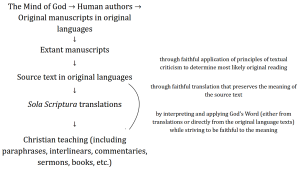
Let us now summarize the authority of Scripture and non-Scriptural teaching, as visualized in Figure 1 below:
Figure 1: Divine authority in translation and teaching
Or, summarized in words:
- God’s Word begins in the mind of God, and he ensures the preservation of his intended meaning in the resulting texts via the human authors.
- These original texts are then copied and preserved over time, with occasional variants introduced, but all under God’s sovereignty. God is able to help those who seek to determine the original reading, and he is able to ensure that his intended meaning is not lost by this process. As new manuscript evidence arises, this “critical text” (our best understanding of the original reading) may be revised, in God’s sovereign timing.
- The critical text is then translated into each language, taking care not to distort the meaning by being overly literal, nor to needlessly resolve ambiguity or put words into God’s mouth by being overly interpretive. (This process will be described in Parts 4 through 8.) These translations, while subject to the higher authority of the original language texts, are able to serve the sola scriptura function of the church in each language. These translations will be revised as any improvements in the translation are found, as the language changes, or as new evidence arises that affects our understanding of text-critical issues or our understanding of the meaning of words and phrases.
- Using these translations or the original language texts, and empowered by the Holy Spirit, teachers and preachers present the Word of God to people, and help them interpret and apply it in their lives. All believers also interact directly with the text, seeking wisdom and understanding with God’s help. Translations that are more literal than what is required for faithful presentation of meaning are treated as helpful windows into the structure of the original languages (see Part 4), while translations that are more interpretive than required are treated similarly to books, commentaries, or sermons that seek to interpret God’s Word for the benefit of the church (see Part 5). Both are included in the general category of “Christian teaching,” which carries a lower authority than sola scriptura translations or the original language texts, but which plays an essential part in a healthy church community.
Sola Scriptura Translations: Worthy of Trust Yet Continually Being Refined
As illustrated above, we can picture a model of divine authority flowing down from God to the original God-breathed texts, then through the copying of manuscripts, translation, and finally interpretation and application in Christian teaching. While the original inspiration and writing of God’s Word is complete, the processes of compiling the critical text, translating, interpreting and applying the Word of God are all ongoing processes still taking place today. Each generation undertakes them in the presence of a sovereign God, and as we humbly approach him, he is faithful to enable us to discern, translate, interpret and apply his Word among our contemporaries. Until Jesus returns and claims his kingdom, the work of Bible translation will continue, because languages change over time, our understanding of the original texts may improve, and the translation of certain words or phrases may be improved upon.
These revisions, however, are bound to be fairly minor, dealing primarily with subtle nuances. Any fluidity in the process should be understood as a continual refining, and should not in any way undermine the trust readers have in faithfully produced translations. God is watching over his Word (Jeremiah 1:12), and he is faithful to help us as we earnestly strive to produce translations that people can hear and truly say, “This is the Word of the Lord.” “Thanks be to God!”
This is part 3 of a series on divine authority in Bible translation. Part 4 will show why overly “literal” translations cannot properly fulfill the sola scriptura function of the Bible, while Part 5 will show why overly “interpretive” translations likewise fail in this regard. The full series can be accessed here:
Part 1 | Part 2 | Part 3 | Part 4 | Part 5 | Part 6 | Part 7 | Part 8 | Part 9

0 Comments